For the well-read golfer, course management strategy forever changed the day Mark Broadie published "Every Shot Counts" in March 2014.
Broadie, a Columbia Business School Professor, used millions of datapoints taken from the PGA Tour's ShotLink system to dispel golf myths that at the time were considered conventional wisdom. To do this he used the 'strokes gained approach'.
What is the 'Strokes Gained Approach'?
Strokes Gained is a statistical method that determines how difficult any given golf shot is, relative to a given benchmark skill level.
The method calculates the average number of shots a player is expected to take, to finish a hole from any position on the golf course.
Statisticians compare how close a golfer's shot finishes from the hole, versus a database of comparable shots from thousands of other golfers of a given handicap.
We can then work out whether a golfer gained or lost strokes, relative to the expected performance of comparable golfers hitting comparable shots.
The calculation requires a database of real world shot data to create "benchmarks" for golfers of different skill levels.
Common benchmarks are a "scratch golfer", a "10 handicap", a "20 handicap" etc. This means an amateur golfer can work out whether they gained or lost strokes for any shot they hit, relative to any standard of golfer for which we have benchmark data.
For example, according to Shotscope Data, standing on the tee of an average par 4, we might expect a scratch golfer to take 4.09 strokes to complete the hole, but from 1 foot, they should get the ball in the hole in 0.99 shots.
This logic can be extrapolated to any shot location on the golf course. All other things being equal, the closer you are to the hole, the less shots you would expect to need, to finish the hole.
The Stroke Gained Approach provided the maths that confirms and quantifies the importance of long hitting in golf.
Conventional Wisdom 'Disproven' by Mark Broadie
- Drive for show, putt for dough? Wrong.
- Elite golf performance is typically separated least by putting; with long driving and accurate approach play proven to be bigger separators.
- Tiger Woods dominated because of his superior pressure putting? Wrong.
- Tiger gained most of his advantage against the field through his unusually accurate iron play.
- Amateur golfers should be disappointed every time they miss a 6 foot putt? Wrong.
- Even tour pros, the best putters in the world, miss about half of their 6 foot putts.
- Aim for the middle of the fairway on tee shots? Wrong.
- The optimal strategy might sometimes be aiming at a bunker, or a patch of rough. In short, this may be optimal if it reduces the chance of taking penalty shots off the tee, even if that means hitting the approach shot from the rough.
I recommend you read the book to understand the detail behind these, and many other interesting revelations.
Students of Broadie
Shrewd golf coaches like Adam Young and Jon Sherman, hosts of the Sweet Spot Golf podcast, soon realised the importance of the book.
The statistics provided, demonstrated that a rational handicap golfer should have much lower expectations regarding their golf game. Understanding shot dispersion, i.e. where all your shots could go with a given club, makes a golfer understand they are standing on the tee with 'a shotgun, rather than a sniper rifle'. They do not actually know where the ball is going to go, so an optimal choice of aim needs to consider all possible shot outcomes.
Statisticians like Lou Stagner, took the study further, with access to the Arccos Golf database of millions of amateur golf shots. He regularly posts on social media, stats around expectations which tend to confound conventional wisdom further. Here's an example:
In a round of golf, a PGA Tour Golfer is more likely to have a hole-in-one than hit all 18 greens.
This emphasizes how rare it is for the best in the world to hit every green in regulation.
Perhaps the most inspired student of Broadie, is Scott Fawcett.
Fawcett is the creator of the Decade Course Management system. In his own words it is:
The Tour-proven course management system to shoot lower scores.
The system has been used by a number of tour pros including Will Zalatoris, Stewart Cink and Keith Mitchell to great effect.
The Main Principles of Decade
Disclaimer: This is a massive simplification of the Decade system!
Firstly, I recommend buying Decade. In Fawcett's app you will get much more detail around the system, and useful tools to help you implement it.
A good introduction to Decade can be found in this lecture Fawcett gave to college golfers which is on the Decade YouTube channel. It has visual examples, which make it quite clear on how to optimize tee shot strategy. Watching this video was a "eureka" moment for me in terms of course strategy. It just makes sense.
Fawcett encourages players to hit driver off the tee on par 4s and par 5s, unless there is a very strong deterrent. For example, there is a very narrow fairway, or a severe hazard which would be reached using driver, but not a lesser club. He generally discourages laying up on short par 4s and on par 5s.
Scott wants to get you closer to the hole, while also minimizing the risk of incurring penalty shots. Decade is based around the 'strokes gained approach'. The idea is to select the shot that, on average, will get you in the hole in the fewest strokes.
On approach shots, Decade encourages aiming away from hazards and avoiding short siding yourself at almost all costs.
If the flag is tucked on the left, with most irons you will be aiming towards the middle, or even right of the green. This is different for different golfers and different holes. The golfer will consider their own shot dispersion (i.e. their skill level), the width of the green and distance from the hole when selecting an optimal target.
Impacts of Decade on Course Architecture
In my opinion, the popularization of course management strategies like Decade, must impact our understanding of good golf course architecture.
Here, we discuss an example, where we presume the architect intends to make the player make a decision around a prominent fairway bunker from the tee.
Let's consider if there really is a decision to make for a golfer using a system like Decade?
The 4th Hole at Walton Heath Old
Firstly, let's imagine the architect needs to cater for 3 golfers, the scratch man, the 10 handicap and the 18 handicap. They carry their driver 270, 240 and 200 yards respectively.
Using the image below, we will discuss the scratch players options, and bear in mind the others.
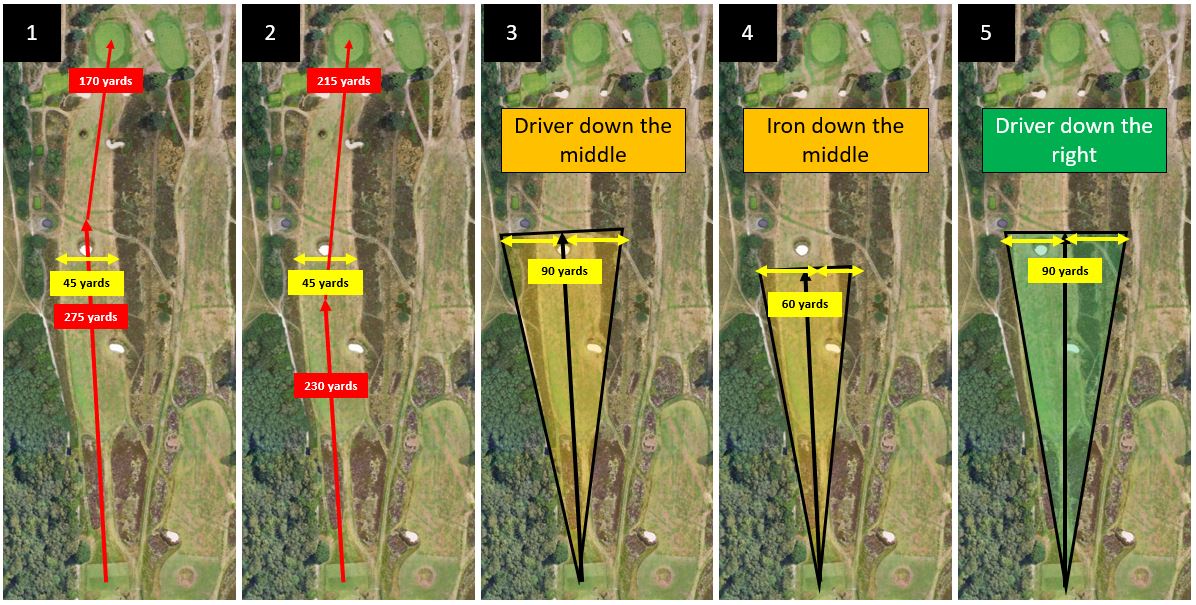
The 4th hole at the Old Course at Walton Heath is a long par 4, with a narrow fairway and a bunker in the middle of the fairway.
There is out of bounds tight to the left and heather to the right. The heather will affect an approach shot significantly, but the ball will almost always be found in it.
The middle bunker is deep, so the golfer will have to splash out.
Consider the images of the 4th hole at Walton Heath:
-
Image 1 - here we show the distance to carry the middle bunker (275 yards), the width of the fairway (45 yards) and the resultant approach shot distance to the green (170 yards).
-
Image 2 - here we show the total distance to be safely short of the middle bunker (230 yards), the width of the fairway (45 yards) and the resultant approach shot distance to the green (215 yards).
-
Image 3 - here the scratch player has decided to aim up the middle with driver. 20% of the time he will miss the fairway left, some of which will go out of bounds. 20% of the time he will miss the fairway right, most of which will end up in the heather. 60% of the time he will hit it up the middle, some will end up in the bunker, some will be short and some will be perfect. His approach shot will vary from 165 - 200 yards.
-
Image 4 - here the scratch player has decided to aim up the middle with 3 iron. 15% of the time he will miss the fairway left, a small number of which will go out of bounds. 15% of the time he will miss the fairway right, all of which will end up in the heather. 70% of the time he will hit it up the middle, some will end up in the right bunker, all will be short of the bunker. His approach shot will vary from 215 - 260 yards.
-
Image 5 - here the scratch player has decided to aim up the right with driver. 20% of the time he will miss the fairway left, all of which will be in bounds, some in the middle bunker and most on the fairway. 20% of the time he will miss the fairway right, all of which will end up in the heather. 60% of the time he will hit it on his aim line, some will be on the fairway but most will be in the heather. His approach shot will vary from 165 - 200 yards.
What are the strategic design considerations for the architect?
For the 10 handicap, he will likely be able to hit driver up the middle, or right of the fairway without worrying about reaching the middle bunker.
The 18 handicap will be worried about going in the shorter, right bunker with his driver, but doesn't have any choice but to hit driver due to the length of the hole.
For the scratch golfer, my interpretation of Decade, would mean image 5 is the optimal strategy to play the hole.
That is three golfers, none of whom, have much of a decision to make off the tee. This is not ideal from an architecture point of view.
The approach shot distance is key. We are much more likely to get a par from 165 yards vs 215 yards. Statistically the scratch golfer can expect to be about 50 feet closer to the hole after approach shots from those two distances. That is a huge difference. It is likely to equate to one more shot to finish the hole.
Also, there is a tendency to assume the lay up shot will be on the fairway. However, as we show with the shot dispersion triangle in image 4, there is a good chance the lay up will need to be played out of the heather anyway.
This means that even if the golfer hits driver into the heather up the right and has to chip out, on average they are likely to be better off if we consider all the possible outcomes of the 230 yard lay up with an iron.
The player must remove the possibility of hitting the drive out of bounds left, because 'stroke and distance' is like a 2 shot penalty. As a result, they must aim up the right edge of the fairway and accept half of their shots will be in the heather, which might lead to a bogey. The pay-off will be none out of bounds.
The signature bunker is so small, that you accept the small chance of going in it and accept it will likely lead to a bogey; again we must avoid the out of bounds at any cost, but we can live with shots ending up in the bunker or the heather.
The traditional architect might assume you would play short of the bunker, but because of the length of approach shot left in; the optimal strategy is to ignore it and aim into the heather.
How would changing the hole affect the optimal strategy?
Now what would be a more interesting design to the hole from a strategic point of view?
Well, if you remove the short right bunker, and remove the heather, so that for the first 220 yards of the fairway it was 20 yards wider, the golfer would have a harder decision to make.
Suddenly, the possibility to almost guaranteeing hitting from the fairway instead of the heather would be quite tempting for the scratch golfer. From a Decade point of view, it would bring the expected strokes from both tee shots closer together.
Wider fairway overlaid onto the 4th hole at Walton Heath:
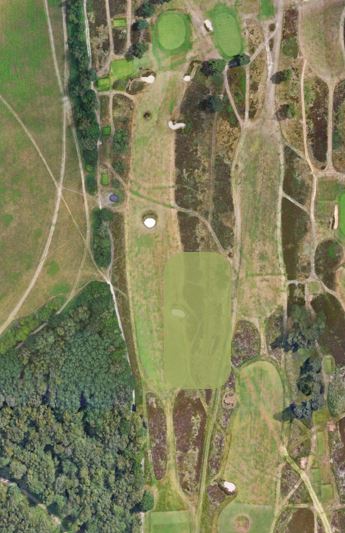
This would give more decisions to make for the scratch golfer, but also reduce the frequency of making the handicap golfer play a long par 4 from the heather.
Now, you could argue this logic results in every fairway being wider at the beginning and tapering at 280 yards.
However, the point here is that the fairway is so narrow, that the hole's signature bunker is just not part of the decision for the Decade educated golfer.
If they aim at the bunker with driver, they know that 40% of the time they are either OB or in the heather anyway, so the bunker shouldn't really enter their mind.
The Impact on Strategic Design Principles in Golf Course Architecture
This is just one example, discussing how a classic, strategic par 4 has been rendered decision-less with consideration of the strokes gained approach.
It is also why I am in favour of the trend of designing golf courses to be forgiving from the tee, often this actually gives the skilled golfer more decisions to make. This aligns with a statistic discussed in Every Shot Counts, whereby shorter hitters will score worse than longer hitters when fairways are narrowed. This is because everyone is not playing from the rough more, but the longer hitters can hit short irons and therefore score better.
Golf is as much an art as a science, and golf course architects should certainly not rip up their existing designs so that every option off the tee and into the green have equal expected strokes gained.
However, where an architect really does want to make a golfer make a decision, they need to be aware of systems like Decade.
Anecdotally, the majority of golfers are not aware of Decade, but that will likely grow over time.
In my opinion any architect designing golf courses in 2023 onwards should consider 'Every Shot Counts' required reading.
